AppReviewToday- AppReviews

  • Geo Gods review

    It's not common for a mobile game to rely first and foremost on delayed gratification. Although individual matches of Geo Gods may only take a few minutes, you have to play several rounds of it for you to even begin posting high scores or really understanding how to use its mechanics to your advantage. In another developer's hands, I may not trust such an experience to pan out well, but as a game from Arnold Rauers I didn't think twice–Geo Gods is a great game well worth sinking time into.
    Enigmatic elements

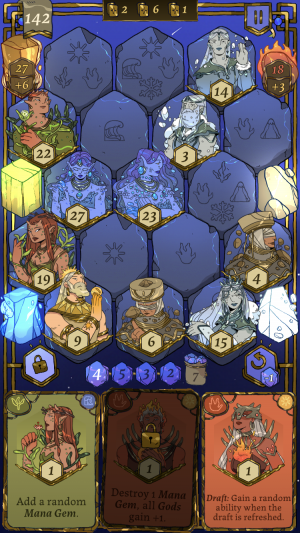
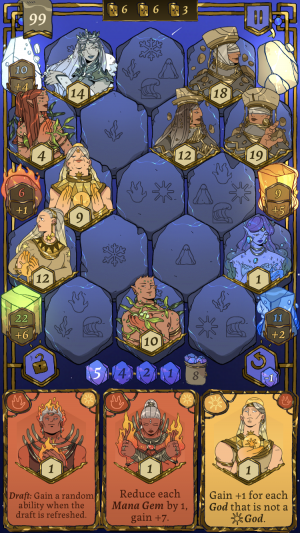
    Geo Gods is a tile placement game where your goal is to fill 17 hexagons with gods drawn from three decks of cards. Placing gods rewards you with points, and each god has their own abilities that can interact with other game elements to boost its own point value or those of other cards. Each time you place a god or elect to skip a turn, you discard the face-up cards on each deck before revealing the next cards in each deck.

    Rounds of Geo Gods end when you fill up the entire game board, run out of mana gems (the currency that controls where you can place gods and how many times you can redraw), or are unable to play any more gods given your hand and remaining pool of mana gems. This all sounds complicated (and it kind of is due to the amount of interlocking systems), but the basic idea remains simple: try to find the best way to make the numbers on your gods go up in any given situation.

    Time and pressure

    If you are anything like me, your first few games of Geo Gods will not go well. You'll place tiles in ways that feel effective, but without more strategic knowledge of what you can expect from the deck, a fuller grasp of mechanics, and an understanding of how some dubiously-worded cards actually work, you'll hit the endpoint and feel pretty underwhelmed and discouraged.

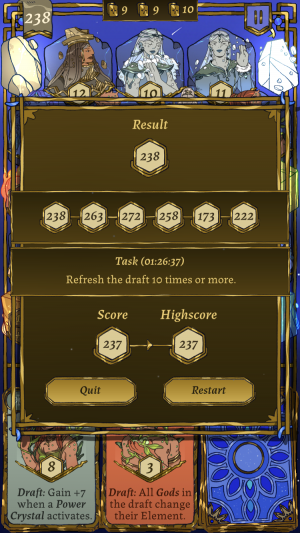
    That's totally ok, though! Geo Gods is designed to be a bit of a slow burn, so much so that your scores don't even post to the leaderboards until you've played at least a half dozen times. Over that time, provided you are committed to experimenting and learning, you'll start to master mechanics like the ideal time to activate crystals, cards you can and should lock, and what to expect from the deck later on in a game.
    Free the gods

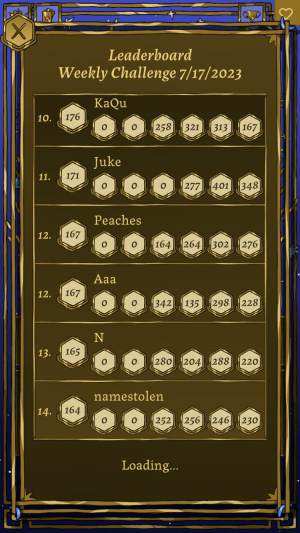
    All of this might sound a bit intimidating, but again, this isn't something to worry too much about. And you don't have to just take my word for it. Geo Gods is a free game that lets you play to your heart's content. If you find yourself enjoying the experience and wanting to really compete in the game's weekly leaderboards, though, you can opt to pay $4.99 to unlock the full game, which includes some additional cards.

    The weekly challenge is perhaps my favorite feature of Geo Gods, as it gives you an opportunity each day to see how you stack up against others while also competing to play the most consistently to net the best average score. This scoring mechanic is a nice way of balancing out some of the randomness in Geo Gods, and is a big reason why the game is currently a daily play for me. It also helps that this game has such a nice and soothing aesthetic, making for a nice little escape to dive into during the day.

    The bottom line

    Geo Gods has a pretty significant learning curve before its placement and scoring mechanics click into place. Once you get there, though, you are left with a very pleasant puzzler with a high amount of variability that will keep you on your toes, especially if you want to shoot for the top of the leaderboard.

    Source link:https://www.148apps.com/reviews/geo-gods-review/
  • Return to Monkey Island review

    Return to Monkey Island answers the question of what you should do with an aging franchise that defined a genre: Give it a proper send-off. This adventure game welcomes the return of its original creators, features some super smart innovations on classic adventure game design, and closes the book on Guybrush Threepwood and LeChuck in a (mostly) satisfying way.

    Find the secret (for real this time)

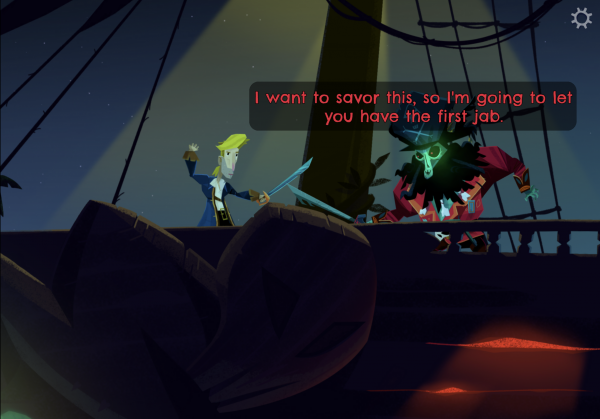
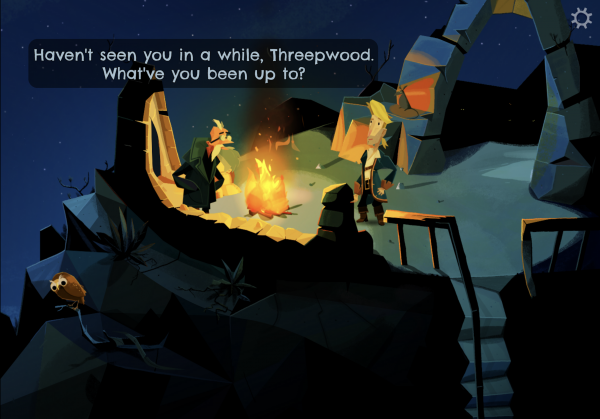
    This latest chapter in the long-running and celebrated Monkey Island series once again focuses on Guybrush Threepwood and his pursuit to uncover the secret of Monkey Island. Only this time, the game opens with a vignette of his son playing with friends (which doubles as a sort of tutorial to teach you how to play the game) before settling on a park bench to hear his father tell the story of the time he actually found the secret he had always been looking for.

    This frame narrative helps set up a story with a momentum that leads players toward where they have long been wanting to go, and features a lot of classic point-and-click adventure puzzles, corny wordplay, and expressive character design that have long been hallmarks of this series.

    Revamped return

    Tonally, Return to Monkey Island fits right in with other games in the series, and even features quite a few callbacks and cameos of iconic moments and characters of games' past. Structurally and mechanically, though, this game feels like a modern realization of the old point-and-click formulas of yore. This is to say Return to Monkey Island definitely still has you doing a lot of the same kinds of item combinations and pixel hunting that other games had you do, but everything is structured and designed in a way to feel more seamless and natural than it has basically ever felt.

    There may have been a time or two when playing Return to Monkey Island that I felt slightly perplexed by a puzzle or task, but I never once felt stuck or without a clue of what I was supposed to be doing next. The game's handy to-do list and optional hint book go a long way in keeping you always on track and moving forward, but there's also a lot of credit to be given to the thought behind all of the puzzle designs in the game, every tooltip that pops up when holding a finger over it, and the way the game writing guides you through its story.

    Goodbye Guybrush

    Another celebration-worthy aspect is the way that Return to Monkey Island tells its story. As a game focused on allowing you to actually discover the secret that has been danced around for over three decades, it firmly and confidently commits to reflecting on Guybrush's legacy and putting an endcap on a series, at for the most part. There are multiple endings to the game (some of which are gags), but some are less satisfying than others, and I almost wish the game commited to a single one. Still though, it is a story lovingly told, and–despite a somewhat abrupt turn toward the end–is a heartfelt send-off for a series from the original creators.

    As for how the game plays on iOS, well, it's basically perfect. Point-and-click style games always tend to work well on touchscreens, but Return to Monkey Island goes above and beyond by having gesture and multi-touch controls that ensure you never accidentally skip past dialog (unless you want to) or select the wrong item when two are close to each other. I imagine it's a great playing game on other devices, but Return to Monkey Island plays so well on my iPad I'm not sure I'd want to play it anywhere else.

    The bottom line

    Return to Monkey Island is a game made with a clear affection for the genre and series itself. It is also a confidently told story with some incredible design work to make sure it still feels like a classic point-and-click game without all of the sore spots that usually come with that.

    Source link:https://www.148apps.com/reviews/return-to-monkey-island-review/