AppReviewToday- AppReviews

  • Dawncaster review

    Dawncaster is a deck-building roguelite that released for mobile devices back in March of 2021. Why am I writing about it now, then? Well, for starters, I somehow only recently became aware of it. Secondly, the game recently updated to add over 160 new cards for free for all players, making it basically a new game. And finally, I am taking it upon myself to write this not-so-timely review of Dawncaster because for the past two weeks it has been basically the only thing I've been playing and I'm still blown away by the things I am discovering and its ability to bring me back in for another run.
    Classy combat

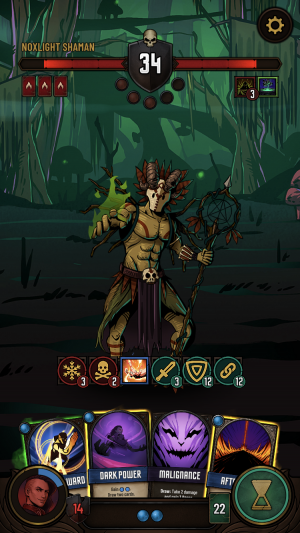
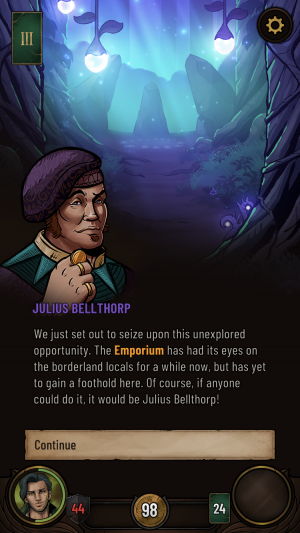
    Conceptually, Dawncaster is nothing new. It's a fantasy roguelite deckbuilder where you play as a hero who fights all manner of evil creatures to level up and fine-tune a deck of combat abilities that thwart even the most powerful demons. Along the way, a quest unfolds and there are also other random events outside of combat that can help or hinder you all along the way.

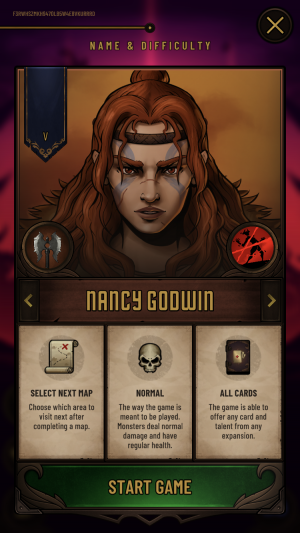
    To help guide your deck-building choices, you start each run by choosing a class along with some starting cards and abilities. At first, these class distinctions don't feel super different, but the further you get into a run and gain access to more cards, equipment, talents, etc. the way you play each class (and even the different deck types within a single class) varies quite dramatically.

    Perfectly portable

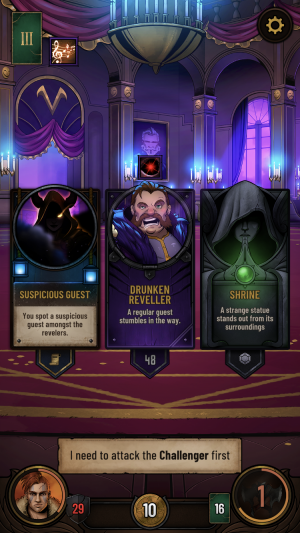
    Reading this, you may be asking yourself what makes the different than just playing deck-building heavy hitters like Slay the Spire or Monster Train? The answer for me lies in Dawncaster being a mobile-first title. This game packs all of the same punch of its higher profile competition, but it does so in a portrait-mode package that reads and plays beautifully and smoothly at 60 frames per second while also being easy on your phone's battery.

    In addition to its technical performance and presentation, Dawncaster is designed to have combat encounters that take just few minutes while still retaining the depth and strategy of other games it takes inspiration from. This makes it a game you can dip in and out of throughout the day as you creep your way through a grand adventure, but also one that plays fabulously for long stretches.
    Draw and redraw

    I am not sure how Dawncaster felt before it dumped 160 cards into its library recently, but playing it now I've gone on at least 30 runs and have seen about 75% of the cards it has to offer and only scratched the surface of its more challenging content like the Sunforge. Every new game still feels like a world of possibility, and that's just from playing the game's base quest (you can bolt on three expansions to for $4.99 each).

    As high as I am on Dawncaster, though, I do have to acknowledge some of its shortcomings. The first is that–as far as its roguelite design goes–you can screw over your run very easily and you might have to play for upwards of an hour from that point to even realize it. Dawncaster can also really feel like a game where your success is extremely luck dependent, though I fully acknowledge that some of that feeling may fade as my skills at the game develop over time. In either case, though, my overall feelings are ok with these design choices simply because of how easy it is to dive back in to Dawncaster to try and master the game all over again.

    The bottom line

    I won't try to sit here and tell you that Dawncaster is better than whatever your favorite roguelite deck-builder is, but I can say with a reasonable degree of certainty that Dawncaster is the most mobile-friendly one I've played. It feels just as robust and varied as other games like it, but done in a way that makes it so easy to hop into no matter where you are or what you are doing.

    Source link:https://www.148apps.com/reviews/dawncaster-review/
  • Six Ages 2: Lights Going Out review

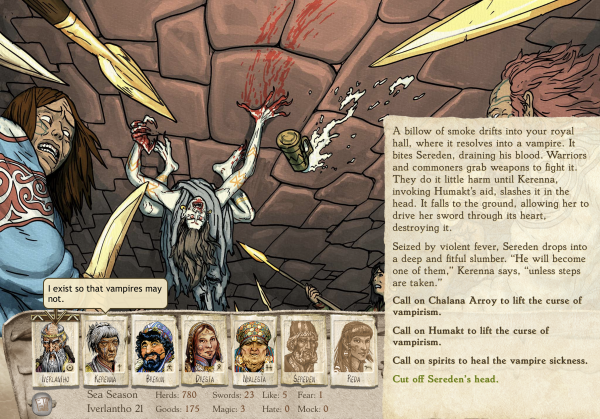
    If you've heard of A Sharp's games (King of Dragon Pass, Six Ages: Ride Like the Wind), then a shortcut assessment of Six Ages 2 is that it is the most fully realized version of these uniquely narrative-focused strategy games. This is to say there is nothing fundamentally different here, but then again, there aren't really any other games that do what these do. Six Ages 2: Lights Going Out takes the idea of creating a lore-rich saga of survival to the most seamless, varied, and replayable places yet, solidifying it as the best game in the series.

    Story > Strategy

    Assigning genre labels to Six Ages 2: Lights Going Out doesn't really help describe what the game is. Although it is technically a menu-driven turn-based strategy game (and also has elements of gamebooks, role-playing games, and management sims baked in), using any of these terms are too… mechanical to capture what the game feels like to play. So yes, while it's true the game is about managing resources to ensure the survival of your clan as the world slowly but surely dies, Six Ages 2 is more about cultural understanding and tactful leadership of people to achieve those ends.

    So, although there are hard numbers and victory and loss conditions present in this game, there is also a layer of lore and personality that constantly rubs up against any ability to turn the game into an optimization puzzle. There are people on your clan ring, for example, who help guide your decisions and may not agree with what you do, and doing things like swapping them out or repeatedly disagreeing with them can cause bigger problems. There are also times where your dwindling supplies may run up against a cultural norm of expending more than usual and you have to navigate what happens if you decide to defy tradition. Decisions like these constantly rear their heads and make for a game where you have to act as a leader supporting what feels like actual people as opposed to simply manipulating commands to make certain numbers go up or advance some tech tree.

    A tale of survival

    As you play through Six Ages 2: Lights Going Out, individual narrative threads take shape and they all revolve a central reality: the world is ending. Gods are dying, resources are dwindling, and demons of Chaos are roaming around and attacking other tribes, many of whom will be completely destroyed over the course of your playthrough. This makes the backdrop of every decision you make in the game being about trying to make the most of pretty dire circumstances, and learning how to lean on the strengths of surviving gods and exceptional clan members to survive for as long as possible.

    This isn't to say Six Ages 2 doesn't have an end, nor is it simply a string of completely random events to manage. There are many complete narrative arcs that weave into one much larger storyline, and–given the amount of different choices you can make in the game–it all feels surprisingly natural. There are some repeated events, but aside from routine combat encounters, those were relatively rare. For the vast majority of the time, my playthrough of Six Ages 2 felt like a complete story that naturally evolved in response to the decisions I had been making, all without really feeling like I could see what was happening behind the curtain.

    How deep is your lore

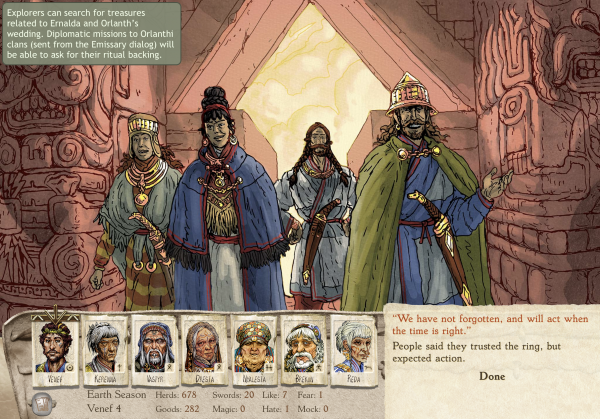
    As much as I want to keep gushing about Six Ages 2, I do want to acknowledge some pretty big caveats to enjoying it. The first is that it's a game that portrays everything through still illustrations and accompanying text boxes. This is to say it isn't particularly flashy, though the art is quite well done and varied. The second is that this game is very big on its lore. You may not know who Orlanth is when you start the game, but you dang well better not only know who he is, but who worships him, what blessings he bestows, and more if you want to be successful in this game.

    This is because Six Ages 2, like the games before it, exists in a universe where mythology drives nearly everything. Thankfully, Six Ages 2 has a good lore book built right into the game that you can reference, and–perhaps even more importantly–the game rarely ever has distinctly right or wrong ways to handle just about any decision. That said, if you want to try and make it all the way to the end of Six Ages 2, you should be ready to take a pretty deep dive into this fantasy world.

    The bottom line

    Six Ages 2: Lights Going Out may ask a lot of you, but what it gives in return is unlike most games I've ever played. This may also be true of the previous games in this series, but the execution here is peerless. Six Ages 2: Lights Going Out is in a league of its own thanks to its particular blend of strategy and narrative gameplay.

    Source link:https://www.148apps.com/reviews/six-ages-2-lights-going-out-review/