
AppReviewToday- AppReviews

  • Abandon Ship review

    The influence of FTL is still holding strong as evidenced by games like Abandon Ship. This game takes all of the roguelike elements of ship and crew management from Subset Games's breakout hit and moves them from the stars to the high seas. There are other ways in which Abandon Ship tries to establish its own identity but most of them aren't very well implemented making for an experience that constantly reminds you of an older, better game you could be playing instead.
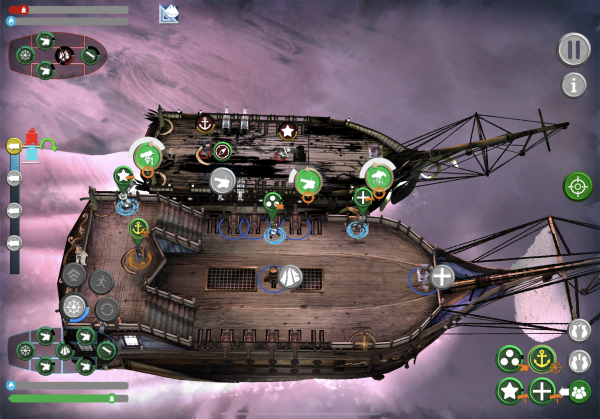
    Captain Cthulu

    In Abandon Ship, you play as a sea captain on the run from a group of seafaring cultists. You start with a crew of a handful of prisoners you freed in your escape and a very basic ship, with your ultimate goal being to stay ahead of your pursuers. Along the way, you sail in open waters, have sea skirmishes with pirates, and can stop off at ports to upgrade your ship, hire new crew, etc.

    Along the way, it's also clear that these cultists are more than just fanatical worshippers. The world of Abandon Ship has some occult and monstrous secrets lying in wait, which mostly borrow from the realm of Lovecraftian horror and its derivatives.

    Clunky cartography

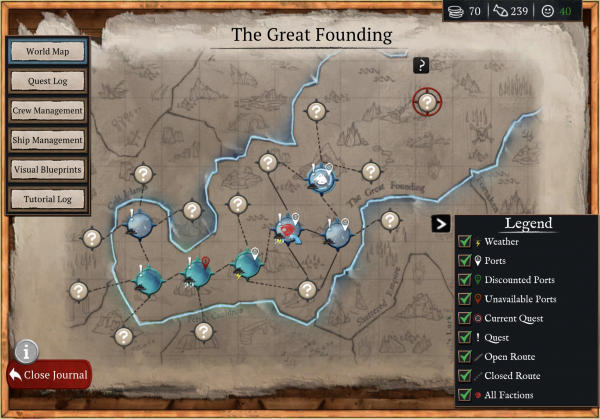
    For the most part, anyone familiar with FTL and the games that have already imitated it will be pretty familiar with how Abandon Ship works. You sail to a location on your map, and while there something or some things happen that you need to react to in order to move on. Abandon Ship is a little different than other titles like this in that each point of interest is like a small open world map that you sail through in real-time. This is to say you might see an event that seems like a battle and decide to take that on first before hitting the port to repair, though you have to weigh these options against the time it takes to explore the map and the ticking timer of when the cultists might arrive to try and recapture you.

    All of this works… ok, but none of it looks or feels particularly great. The polygonal visuals are all pretty rough, as are the parchment-textured dialogue boxes and overlay UI elements that highlight events, units, etc. None of it feels super cohesive and functionally certain things like sailing around the map or scrolling through menus don't quite work the way you want them to. Because of the real-time nature of the game, this can create some problems, though Abandon Ship does handily provide a pause button that you can use at virtually any time to queue up commands or just assess your current status.
    Test the waters

    If you're curious about Abandon Ship, the game is a free-to-start title, giving players about 15 minutes of time with it before offering a few different options to pay and unlock several different campaigns and modes. Despite its brevity, this demo does give a good window into the way it looks, feels, and controls, and your comfort with those things are primarily what will affect your overall enjoyment of it. The stories from the campaigns and the level of randomized events are all serviceable with their main hook being their repeatability and your ability to strategize around completing them, and there is plenty to do even if you only pay into the main campaign unlock and not the others.

    I enjoy the time I spend with Abandon Ship, but I can also never shake the feeling that I could be playing any number of games of the same mold that find more elegant and appealing ways to offer this kind of survival/combat/management/roguelike experience. Since all of these games are built around replayability, it's also hard to think of these older games as something that have been exhausted and can't be returned to. So, unless the high seas backdrop or Lovecraftian aspects of Abandon Ship speak to you in particular, I'm not sure there's a whole lot else this game offers that's better than what can be found elsewhere.

    The bottom line

    Despite some rough edges, Abandon Ship is a perfectly serviceable roguelike in the vein of FTL. The only problem with this is it's not different enough from other classics in this genre, and what it does do isn't quite up at the level of games that came before. This makes it a decent pickup if you really just need a new-looking kind of this game or cultist and pirate aethetics really speak to you personally. Luckily, if you're not sure, the opening demo version of the game is rather informative of what you can expect from the full game.

    Source link:https://www.148apps.com/reviews/abandon-ship-review/
  • Diablo Immortal review

    In playing and then reading about reactions to Diablo Immortal all this past week, I've been feeling like everyone's talking about a different game. All of the pearl clutching about a free-to-play game having a high ceiling on just how much money you can put into it feels incredibly out of touch, even anachronistic, with regard to the current gaming landscape. What makes conversations about it even stranger is that there isn't even a good reason to even think about giving a cent to Blizzard for Diablo Immortal. This mobilized version of one of a gaming giant's beloved franchises is a finely tuned social space with Diablo stuff shoveled on top of it. It is very good at being exactly that save for some pacing issues that have absolutely nothing to do with it being a free-to-play experience.

    Yep it's Diablo

    To back up a second, the Diablo games are dark fantasy rpgs where you pick a character class (e.g. Barbarian, Wizard, etc.) and go on dungeon raids where you use all kinds of class-specific abilities to kill tons of hellish creatures while loot and gold fly out of them. You then use this loot and gold to make your character stronger while also leveling up, unlocking new skills, and the going out to fight even stronger creatures.

    Diablo Immortal does all of this just fine. Perhaps the most notable departure from the series's core formula is the way it exports some of the most powerful and unique ways to customize your character from a system like a skill tree onto gear which you have to grind through repeatable dungeons to find and power up. It's hard not to view this change cynically as it clearly creates a situation where leveling up alone doesn't allow you to play your character the way you want, but in the grand scheme of what Diablo Immortal ultimately is (more on that later), it doesn't feel as nefarious as it sounds.

    Follow the path

    Another way in which Diablo Immortal somewhat departs from the Diablo mold (at least from the first two games, anyway) is that it isn't just a straightforward and linear story game. In fact, if you are curious about playing Diablo Immortal for its story, I recommend you steer clear. There is a campaign to play through, but it is mind-numbingly boring and has some experience-gating that forces you to do a bunch of other side activities to be able to keep working your way through it.

    As for these other activites, there's an almost overwhelming number of things to do, but you don't really get a full taste of what they are, why they matter, and how they impact your character until you've dumped a lot of time into the game already. Until you get to around level 40, Diablo Immortal feels extremely aimless. There's not really a whole lot to do except follow the literal footstep paths drawn by your quest log to do a lot of the same repetitive actions over and over again without feeling like you're getting particularly stronger or facing challenges that ask you to play differently.

    Talk about loot

    As you start entering the late stages of character leveling, you are invited to prepare for a co-op raid, and this is one of two modes in Diablo Immortal that provides some significant challenge, provides a meaningful goal for players to work toward, and isn't a pay-to-win hellscape like the game's competitive multiplayer mode. Once this happens, leveling certain kinds of loot, equipping different kinds of abilities, and even working together with players in your party actually starts to feel like it matters.

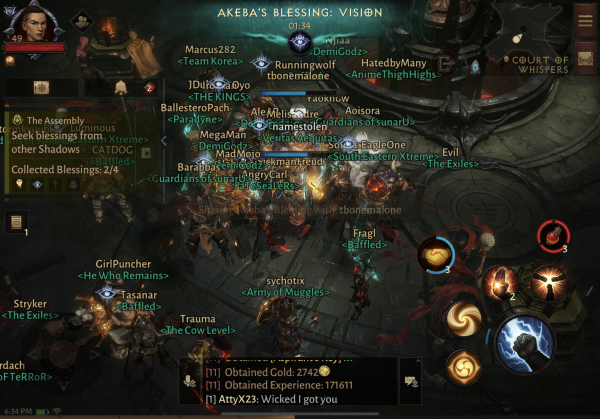
    Outside of that, there are still a ton of things to do that can grant rewards, and those rewards now suddendly feel like fuel to burn toward achieving raid readiness. Many of these activities are somewhat rote and repetitive combat trials, but there are also some interesting social events to take part in, like The Shadow Assembly, which is a player gathering of an in-game secret society you have a win a lottery to get into.

    It wasn't until all of these kinds of options opened up alongside a clear goal to work toward that Diablo Immortal made sense, but even now as I plan to continue playing it, I'm definitely more drawn in by the ways in which Diablo Immortal smartly encourages social interaction and play more than the actual actual actions I'm performing at any given moment. The way Diablo Immortal auto-suggests grouping up with players close to one another working on the same quest, or allows queuing for certain game modes no matter where you are in the world, or even how you can so seamlessly add or drop yourself from a party are the kinds of innovations that excite me most about playing it. In this way, Diablo Immortal feels way more satisfying as a social space where play happens than the majority of the core Diablo tasks you're constantly incentivized and asked to perform.

    The bottom line

    Diablo Immortal is a fine social rpg with a pacing problem. It weaves together some the most intricate, fascinating, and innovative systems for interacting with other players I've ever seen (particularly on mobile), but buries a ton of it under what are somewhat flat but otherwise serviceable action rpg combat and progression systems. None of it feels meaningful until you are finally given a goal, and once you're there, it's a pretty fun upgrade treadmill with monetization that will only bother you if you want to try and compete with people who can happily afford spending an unreasonable amount of money to feel a sense of false superiority in a video game.

    Source link:https://www.148apps.com/reviews/diablo-immortal-review/